|
February 2017 - Jim Lawrie
Notes of meeting held on
Friday 24th February 2017
From the time the programme
for the Society was issued, this meeting had been eagerly
awaited by the members and this was proved to be the case by
the excellent attendance.
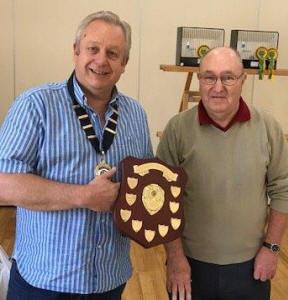
Graham Cornwall opened the
meeting by announcing the death of Geoff Dell, before
introducing Jim Lawrie, although no real introduction was
needed, and added that it had taken a long time to get Jim
“in the chair” for this question and answer session.
The Questions and Answers
are below.
The questions asked resulted
in answers being given in an honest, informative and
entertaining way. It can be seen from the answers from Jim
that he had a few breaks from the hobby, and these occurred
mainly due to his D.I.V.O.R.C.E.s, which appeared to be his
second hobby; only joking.
Jim showed that he really
loves the hobby and regrets that not many of the younger
generation are inclined to take up the hobby for various
reasons, one of which is money.
|
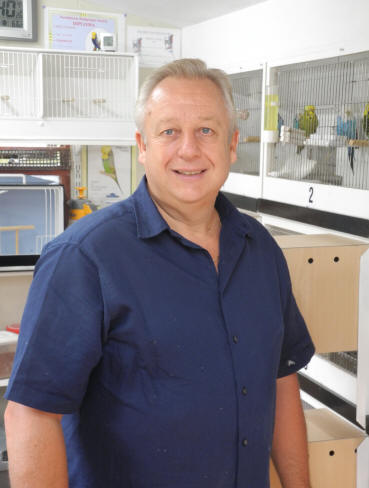 |
JIM
LAWRIE: A QUESTION & ANSWER SESSION WITH GRAHAM
CORNWALL AT NORTHDOWNS’ BS, FEBRUARY 2017
|
THE EARLY DAYS
Q1. How and
when did you get interested in budgerigars?
·
I
started keeping budgies around 1967. I was 13 years old. At
that time I worked on a market stall that sold pet items on
Saturdays and Wednesdays (before and after school) for
pocket money. That stall sold budgies too. It was then I
became hooked, I acquired a pet sky blue budgie and later
got some for breeding.
·
Around 1968 I joined Basingstoke CBS, which had a sizeable
budgerigar contingent. This was in the days before local
Specialist Budgie Clubs existed.
·
For
various personal reasons, I have had to give up budgies
several times over the past 50 years. I have been in and out
of the hobby 4 times now, having returned to the hobby in
the 2007 and now hope to stay!
Q2. What was
your first aviary set-up like?
·
My
first set up was very basic. I built a small wooden aviary
about 4’ x4’ with a small roosting flight and an outside
flight of about 6’ x 4’. It was too small for breeding
cages, but I had 6 breeding cages in a small coal-house
brick building. It was very much a “Heath-Robinson” set up.
Q3. Can you
remember your first major Out-Cross?
·
Yes, it was in 1968. I decided to buy from a breeder who was
having success on the show bench. That man was Cean Roberts
from Lancing, Sussex. He was then exhibiting a successful
line of dominant Pieds and winning Best in Show with a
dominant Pied cock.
·
I
saved up my pocket money, earned from working on the market
stall. It was in the days when you could send away for a
bird and it would be sent off to you by rail.
·
I
purchased (unseen) a skyblue dominant pied cock and a
cinnamon light green hen for the princely sum of £12 (for
both).
·
Those were the days when the BS Colour Standards favoured a
Pied showing a band, but this is no longer a requirement
today. Although hard to fix, for me the band was the real
beauty of this variety.
Q4. When did
you first drop out and return to the hobby?
·
I
would have been around 21 years old – other interests took
my attention!
·
It
was not until 1990, then married with two children, that I
rekindled my interest in budgies. I then obtained birds from
the John Gorrell and Alan Deamer partnership, who were
benching some quality birds based on the Cornish stud of
Rodney Harris. I also went direct to Rodney and bought 9
birds.
·
This bloodline did well for me. In 1996, at the Northdowns’
BS Open Show, which attracted over 1200 birds benched,
I won 2 Class A Challenge Certificates with a Light Green
cock and a Grey Green Spangle cock.
·
Unfortunately, due to personal reasons, I again had to give
up budgies in 1997. And my attempt to breed a reasonable
stud of exhibition budgies came to a sudden end.
·
But
the budgie bug had well and truly bitten me. I returned to
the hobby in 2000. Though in 2005 I again had to drop out.
·
Having re-married and moved to Andover, I started up again
in 2007.
Q5.
What
appealed to you about budgerigars?
·
The
wide range of colour varieties, and that you can take up
budgies at various levels: eg breeding for colour or just
pleasure, or breeding for exhibition purposes.
·
I
like the challenge of trying to produce a good exhibition
specimen of the “modern” type of budgie, displaying good
directional feathering.
BACK IN THE
HOBBY TODAY.
Q6. Who have
been your major influences?
·
On
returning to the hobby around 2007, I contacted Rodney
Harris (Cornwall) to see if he could sell me some stock to
get started again. He said he couldn’t help me at that time,
but advised that I obtained the “modern” type of budgie from
Les Martin, John Crook and Shiela Burns partnership, or Ken
Fagan.
·
I
managed to obtain over 20 birds from Ken Fagan, over an 18
month period, until he himself left the hobby.
·
Around 2008, I was told about this fancier in Farnham who
was breeding the type of “modern” budgie I wanted to breed.
His name is Mike Ball. Since then I have been fortunate to
obtain quality birds regularly from Mike. I have seen him
develop significantly his birds over the past 8 years into
the world class stud he has today.
·
I
have also obtained an outcross or two from you, Tony Cash,
whose birds also have Mike’s bloodline in the background.
·
And
before his exit from the hobby, I also managed to obtain
half a dozen birds from Andy Hind, which carried Huxley &
Marchant’s bloodline. More recently I have obtained some
birds from Barry Lowe, Brixham, Devon, Arthur Piper,
Cornwall, and a Martim Heylen outcross (sky spangle cock).
Q7. What is
your current set-up like?
|
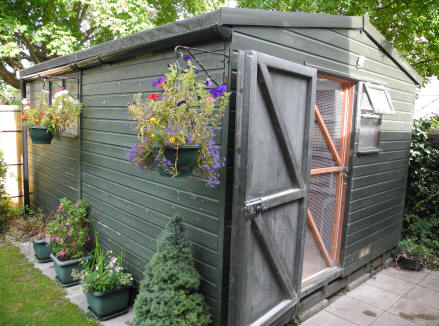 |
Due to having a small garden my present set up is
very modest in size. It is a 10’ x 14’ apex wooden
shed.
·
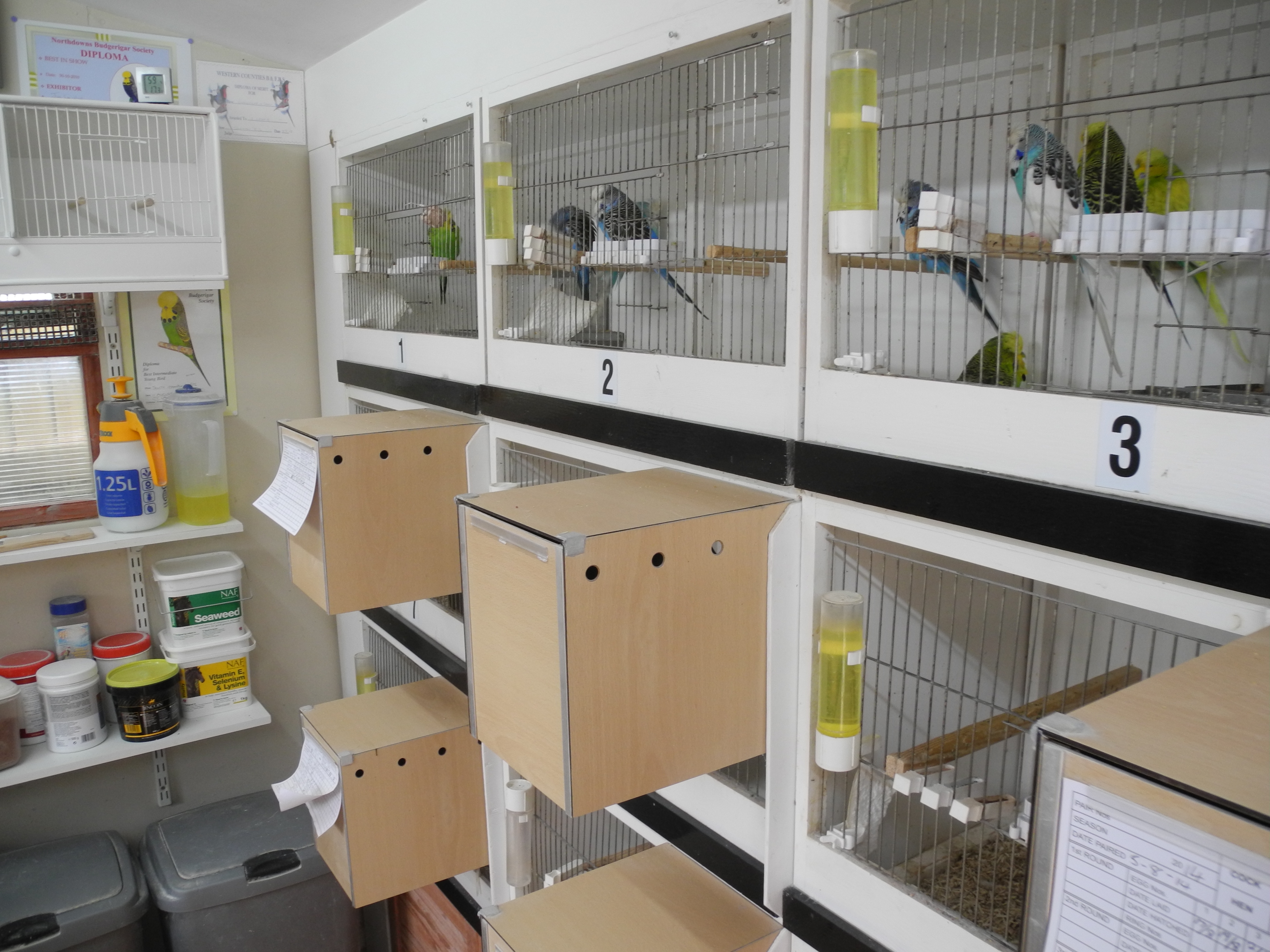
I have 18 breeding cages and 4 stock cages, with two
small internal flights (7.5’ x 4’ and 3’ x 4’). One
is for adults and the other for current year birds.
·
My birdroom is well insulated, roof and walls, with
foil-backed high density foam – not only does this
help reduce sound for the neighbours but avoids
extremes of temperatures in the summer and winter. I
also have two fan windows at either end of the shed
and four (letter-box sized) grills in the shed walls
for ventilation. |
|
Having a small birdroom, I utilise every bit of
space to maximum advantage. It is a bit like the
“Tardis” inside! I have storage facilities
underneath the breeding cages and also the under the
stock cages, where I can store some show cages and
other accessory items for the birds. I also have
room for my hoover and floor bedding used for the
cages and flights. At the far end of the shed next
to my breeding cages, I have a small cupboard to
store my sweeping brush and some medicines etc.
·
My 18 nest boxes are made from compact laminate by
Oestringer. These are a half box within the nest
box, with replaceable concaves. I find these nest
boxes easy to clean and maintain, and with the
laminate joints glued and sealed there is reduced
risk of mites. |
 |
·
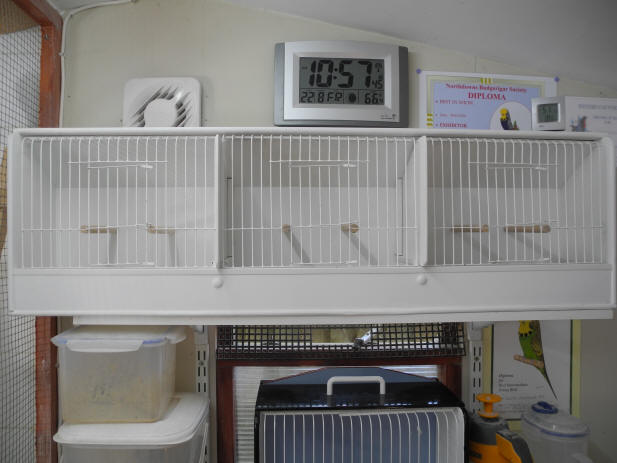
I
also have a row of three training cages at the end of the
birdroom, which I use for selecting birds for shows and
selling birds.
Q8. What
lessons learnt have been employed in your current birdroom?
·
I
have had several birdrooms in the past. My present set up is
a lot smaller than my last one - 22’ x 10’ with 24 breeding
cages and two flights at each end and 12’ x 4’ outside
flight and plenty of cupboard storage.
·
I
improved the design of my current birdroom by having
fan-windows at either end to allow for the free flow of air.
But there is always things you wish you had designed
differently! I would provide more ventilation and larger
extractor fan.
·
Ideally, I would like to have a bigger birdroom that would
give me more cages and flights, and more space for visitors.
You can just about squeeze 3 people into my birdroom
(depending on their size!)
Q9. What are
your views on outside flights?
·
There are pros and cons. Outside flights provide your birds
with exercise, sunlight and fresh air, which helps provide
the birds with vitamin D and exercise. It is also nice to
watch the birds from the garden.
·
The
downsides, I think, are that some of the birds we are
breeding today would not use outside flights frequently, if
at all. Outside flights can also take up valuable space
(especially if you only have a small garden).
·
There is also the risk of contamination from wild birds to
consider, and you possibly risk annoying neighbours in a
built-up area with the noise of the birds.
Q10. How many
birds and what varieties do you keep?
·
Like a lot of fanciers, I suspect I carry far too many
birds, at least more than I need – over 150. I really don’t
need to keep so many - if I haven’t used a bird in the
previous season I should get rid of it.
·
I
would like to keep twice as many hens as cocks, but the
ratios don’t seem to work out like that for me.
·
I
keep a high number of normal Cinnamons and also have
Spangles and Dominant Pieds. I have a soft spot for Dominant
Pieds, as I started breeding with them as a boy in the late
1960s. It is a pity that the BS Colour Standards no longer
require dominant Pieds to show a “band”, which to my mind is
the real beauty of this variety.
·
But
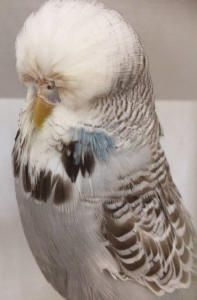
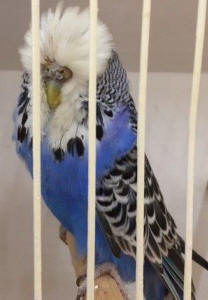
my favourite budgie is a good “modern” type budgie
regardless of variety.
MANAGEMENT
Q11. Describe
your daily management routine?
·
Now
that I’m retired (over 5 years now), I can spend more time
with the birds. When I was working in London, I was only
able to do basic maintenance until the weekends, as I left
early in the morning for work and returned late in the
evening.
·
I
enter the birdroom about 9am (and several times during the
day) and scan the birdroom to see that all birds are looking
ok. I will then sweep up, and spray around with F10
disinfectant.
·
I
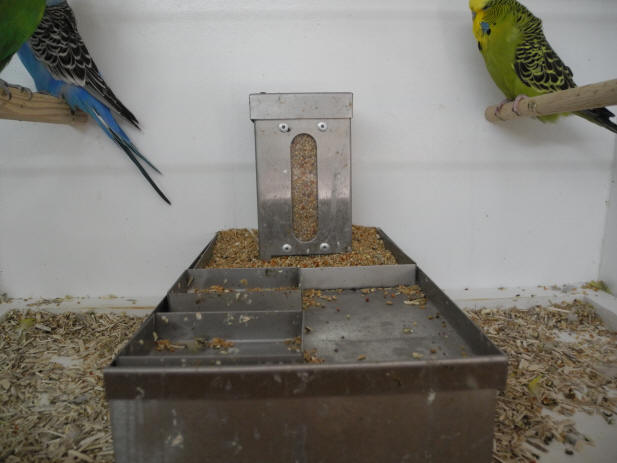
top up seed hoppers in the cages and replenish the drinking
fountains, and top up the soft food as necessary. I do the
same with the flights.
·
I
now use Witte Molen moist softfood, as it doesn’t go off. I
used to use Deli Nature mixed with carrots and greens and
supplements, but this can go off quickly.) There is now less
risk of the birds eating contaminated softfood, and it is
easier to manage.
·
Finally, I check the pairs in the breeding cages and the
nest boxes, ringing chicks if required. And make sure all is
ok with the birds in the flights.
·
The
advantage of being at home during the week is that I can now
spot at an early stage any problems arising and try and deal
with them.
Q12. What do
you do differently during breeding, resting, showing?
·
I
do not vary my routine significantly throughout the year. I
supply the same seed mixtures.
·
In
the breeding season, I do provide the breeding birds with a
constant supply of vitamins and minerals in finger drawers.
I use Murphy’s minerals; Hormova, mixed with dried seaweed;
and Thrive and Gloss. I also add Vers laga “Ferti-vit”
(multi – vitamins, with added vitamin E) and alternately
Orega-Stym in the drinking water.
Q13. Describe
diet, supplements, softfood etc. Do you ever try new
products? How influenced are you by what others are doing?
·
I
do not change routines and diets simply to follow the latest
fad. I think there is some advantage to being consistent in
your regime if it has proven successful for you. If it ain’t
broke don’t fix it!
·
I
provide my birds with 50% plain canary and 50% white
millets. Separately, I feed tonic seed mixed with some small
parakeet seed, though you need to watch that the birds do
not become overweight.
·
However, as I have said I have recently gone over to Witte
Molen moist softfood. The advantage is that it doesn’t go
off, so doesn’t need changing daily.
·
I
feed separately plenty of carrots and broccoli and other
green food. The birds especially like Lambs Lettuce and I
also give them corn on the cob at least once a week.
Q14. What
lighting times do you use? How do they vary throughout the
year?
·
I
use two 5’ all-day fluorescent strip lights, which come on
at 7am until noon and from 2pm until 10.00pm. This is not
varied throughout the year.
·
I
believe giving the birds a quiet rest period during the day
is beneficial for them, and encourages the birds to mate.
·
Budgies tend to mate first thing in the morning, so
effectively creating a second artificial morning at 2pm
encourages further mating to take place. Hopefully this
regime helps improve the chances of successful matings.
Q15. What
gadgets are there in your birdroom?
·
I
have two air filters to help keep the dust down and a vacuum
cleaner
SUCCESS WITH A
SMALL STUD
Q16. What
special features do you look for in a budgie?
·
I
realise there is more to an exhibition budgie than just head
quality, but believe that it is the “face” that first
catches the judge’s eye. And I think it is important to make
this impact when showing.
·
However, my aim is to breed a complete well balanced
exhibition budgie – which has good deportment, length of
feather giving that full face and directional feathering
above the eye and free from any flecking.
·
But
this is my ideal, which may not be the reality!
·
Bringing in top quality out-crosses can be expensive. But I
have always worked on Gerald Bink’s principle that you sell
10 birds and buy one. Trying to improve the overall quality
of your stud over time.
·
So
even a small breeder can make progress adopting this
principle. Any monies produced from sales birds is recycled
back into my “Budgie” kitty.
·
I
now realise that you just don’t tell the wife how much you
have sold birds for a certainly not how much you have paid!
Q17. What is
your approach to pairing up, and how important is pedigree
versus visual, colours and varieties?
·
Like many others, I make pairing selections in my head well
in advance of the breeding season. But when it comes to
pairing up, my ideal selections are not always ready for one
reason or another, and we then have to find substitute
partners.
·
To
make matters worse, we sometimes find pairs are not
compatible in the breeding cage or are not breeding-fit
therefore clear eggs result. So, again we have to resort to
the substitutes bench.
·
I
am more of an “inbreeder”, than an “out-crosser”. I believe
that provided you have good quality foundation birds from a
well bred stud to start with you are more likely to breed
that winner by “fishing in a small genetic pool”.
·
But
periodically you need to refresh the blood by bringing in
birds, but this can still be done by buying from related
bloodlines.
·
Family lines are important to me when pairing up. Clearly we
all would like to pair up two super birds together, but I
believe that a lesser visual bird from a good visual parent
(cock or hen, ideally both) is genetically capable of
producing a good one.
·
I
think provided your birds have good pedigree in the
background, then you are on the road to success.
·
When pairing, I do not double up on faults but try and
double up on desirable features eg, directional feathering.
This does not mean you should exclude “balance” in your
pairing decisions.
·
I’m
not too concerned about what colours I pair together, though
I do like dark factor blue series birds. It is the quality
of the budgie I’m more interested in.
·
I
would, however, have reservations about pairing Dominant
Pied to Dominant Pied, as double factor Pieds lose their
variety colour content. Unless of course it is your aim to
use double factor pieds to breed more single factor pieds in
the following breeding season.
·
Spangle are different altogether. I do pair Spangle to
Spangle to control the number of Spangles produced, and to
produce some Double Factor Spangles!
Q18. How long
will you leave a pair together before splitting them up?
·
Obviously you have paired up a particular pair for a
specific purpose, so had I the luxury of more breeding cages
I would probably leave them together a little longer.
·
But
not wishing to tie up good birds for too long, nor the
breeding cage, I would normally leave a pair together for
around 3-4 weeks before finding suitable alternative
partner(s) or a new pair for the breeding cage.
Q19. With a
limited number of breeding cages how do you manage a clear
first round?
·
Following a clear first round, I will let a pair have a
second round - which usually results in fertile eggs.
Q20. How do
you make maximised use of 18 breeding cages?
·
By
having a quick turn- over in cage usage. If one pair is not
being productive I will release their cage to another pair,
or find an alternative partner for one of the birds.
·
I
will also consider fostering chicks out to let them get on
with another round. I am less keen on fostering eggs out in
case they become addled.
·
So
far, I have not tried running a cock with two or more hens
simultaneously.
·
I
normally expect to breed around 80 birds a year.
Q21. What are
the benefits of working with a small(ish) number of birds?
·
The
advantage is that you tend to be more focused on keeping
birds showing (and carrying) the desirable features that you
want to see in your birds.
·
As
I operate a fairly closed stud – though I do bring in fresh
blood occasionally – there is the benefit of building up a
family of birds with a degree of consistency in the
desirable features you want to see. This, in my opinion,
improves your chances of breeding that winner.
Q22. Are there
risks working with a small stud e.g. over-crowding, no room
for quarantine, end of a line etc?
·
There is the risk of over-crowding, but a small set up does
encourage you to be more selective in the birds retained.
But as you will testify, Tony, I’m guilty of hanging onto
too many birds that I’m unlikely to use!
·
I
do not see any danger in coming to the “end of the line”
with my birds, as there is always a feature that you could
bring in to improve your stud. It also wise to bring in
fresh compatible bloodline occasionally to ensure your stud
does not become too in-bred.
·
Whenever possible, birds I bring in are straight away put
into a breeding cage with a mate. Although not a sure-fire
way of quarantining birds it minimises direct exposure to
other birds.
·
Furthermore, birds are a long time dead, so you might as
well try and get chicks from the outcross as soon as
possible.
SHOWING.
Q23. How many
times do you show each year and how many birds do you show?
·
I
support my two local Clubs – Northdowns and South Hants. I
only started showing at Open Shows in 2012, in order to test
that I was making some progress with my birds.
·
I
personally do not show bought birds, as I feel there is no
real credit to the exhibitor.
·
I
am not a keen exhibitor, I prefer the breeding season. I
tend to show at two Open shows each year- South Hants and
Swindon. I have been relatively successful at these Open
Shows.
·
I
have won 4 Best in Shows at major Open shows.
|
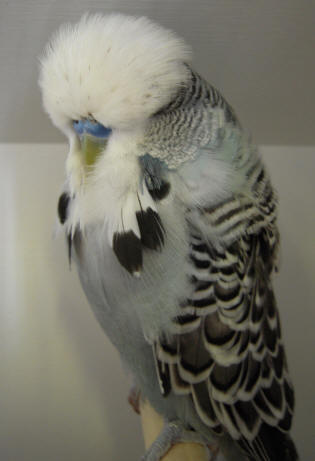 |
In 2013, as an “Intermediate”, I was fortunate
enough to win Best in Show at both South Hants and
Swindon Open Shows, with two different birds (both
Greys).
·
In 2014 I moved up to first year “Champion”. At
South Hants, I obtained 6 CCs and was awarded the
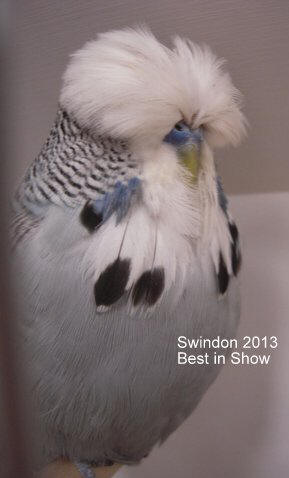
Best Young Bird in Show (with a Cobalt cock). At
Swindon, I won another 6 CCs and got Best Opposite
Sex Any Age (with a Cinnamon Grey Green hen). |
 |
·
In
2016 I won BIS at South Hants and Swindon Gold Open Shows
with a Sky cock.
·
I
think this demonstrates that you do not necessarily have to
have that large birdroom and stud to produce winners. Small
breeders can compete successfully on the show bench with the
big boys too.
·
An
advantage of using a small number of breeding cages is that
it focuses you on using the cages effectively and that you
do not simply pair up birds for the sake of it.
·
The
emphasis should be on producing “quality not quantity” –
though I do hope to breed over 100 birds a year – though I
accept that with greater numbers bred you are more likely to
increase the number of good ones.
Q24. How much
effort do you put into show preparation?
·
To
do your birds justice on the show bench, it is important to
prepare the birds as well as you can. This also means
ensuring that the show cages are in good order.
·
I
catch birds up about 3-4 weeks before showing and put them
into stock cages to get them to settle down and put some
weight on after some have been months in the breeding cages
or flights.
·
I
do not pull spots 4 weeks and tails 6 weeks in advance of a
show, as was a practice advocated in the past. I would not
wish to risk spots and tails not re-growing in time!
·
I
shampoo the birds about 3 weeks before a show - fully
immersing them in clean water to rinse them off. I repeat
this process in the following weeks if necessary. I will
concentrate on the birds’ faces. I will also give them daily
a fine spray with clear water.
·
About a week before the show I will start to dress the
masks. I do not usually fully de-spot a bird at one go. In
some cases there are rather a lot of spots, and I do not
want to over-stress the birds.
·
There is also the risk of pulling the wrong spots if you are
not careful, or inadvertently loosening the correct spot
with the possibility of it dropping out later.
·
In
short, I believe it is important to spend time preparing
your birds for shows to present them at their best, after
all they are your ambassadors!
GENERAL STUFF
Q25. Which
part of the hobby do you prefer i.e. breeding, showing,
social side, attending meetings etc?
·
I
much prefer the breeding side of the hobby to showing. I
also like the social side of the hobby, and talking about
budgies to people that visit me. But I should take up the
numerous invitations I’ve had to visit other people’s
aviaries.
·
I
do like going on Clubs’ organised aviary visits and
attending the BS Club Show, as this helps build camaraderie.
Q26. Is there
anything in the hobby that really gets on your nerves?
·
I
believe some doubts remain with BS judges and the hobby
generally about the definition of longflights and longtails.
·
The
budgie has been evolving since introduced into this country
in the 1840s. Today’s budgie is a far larger specimen than
in yesteryear.
·
So
judges should take into consideration that even if these
“modern” larger birds’ tails do touch the show cage floor
they should not automatically be dismissed as longtails/flights.
·
In
my mind, the important factor to consider is whether the
bird is in proportion and balanced.
Q27. How has
the hobby changed?
·
From first becoming interested in budgies back in the late
1960s to the present, I have seen a dramatic change in size,
feather quality and structure.
·
Even over the last 10 years, there have been significant
advances with the “modern” budgie showing greater length and
density of feather and directional feather over the eyes.
·
There has been a significant decline in the BS membership.
This has meant smaller and fewer Clubs and Open Shows.
·
I
cannot see the hobby going back to the days of the 1980s and
90s where shows had entries of 2000 plus – even the BS Club
Show is failing to get these numbers!
·
I
also miss the camaraderie of those days when budgie breeders
were within easy reach and the Sunday morning drop in for a
cup of tea and chat about the hobby. Nowadays you have to
drive some 50 miles to visit another exhibitor and with life
style changes it may not be convenient to do so.
·
I
also think that new-comers to the Hobby are more competitive
than in my day. They want over-night success. Many of them
no longer approach the next breeder up the status line for
birds, nor seek a mentor, but go straight Champions. They no
longer want to serve an “apprenticeship”! |





















.jpg)